
SSL certificate | Meaning | Definition

The emergence and importance of SSL certificates
The internet is an infrastructure that connects computers through telecommunications. Its development began in the 1970s, but the internet as we know it emerged in 1993 with the arrival of a service called the World Wide Web, or WWW. As this service developed and improved, a large share of buying and selling moved online. Need sneakers, a new television or a bed? Today, you can buy all of these “in two clicks” and have them delivered to your home within a few days or even a few hours.
However, as online shopping developed, the number of fraudsters and hackers misusing and intercepting personal data to steal money also grew.
To make an online purchase, you need to provide personal information, a username, password, credit card number and more. These data are sent from the website to the server and become an “easy target” for hackers in the process.
All of this created fear and mistrust among people buying and selling online, and something had to be done to solve the problem and protect users from fraud.
What is SSL?
In 1994, Netscape developed SSL (Secure Socket Layer), which provides encrypted data exchange between a client's browser and the company's server through which they communicate. The purpose of an SSL certificate is therefore to transfer users' personal details, passwords and credit card information securely, in encrypted form, from the client to the server.
Data encryption turns every number or letter from your credit card into several hundred characters before it reaches the company's server, making it almost impossible for data in this form to be
intercepted online and fall into the wrong hands. This is supported by numerous studies which have repeatedly confirmed that breaking intercepted data (even if they could be intercepted) would take several decades using the most advanced computers and algorithms.
How can you recognize a website with an SSL certificate? The answer is very simple.
When a client communicates with a website, data is transferred using the regular HTTP protocol, meaning it is not encrypted and is visible to outside parties.
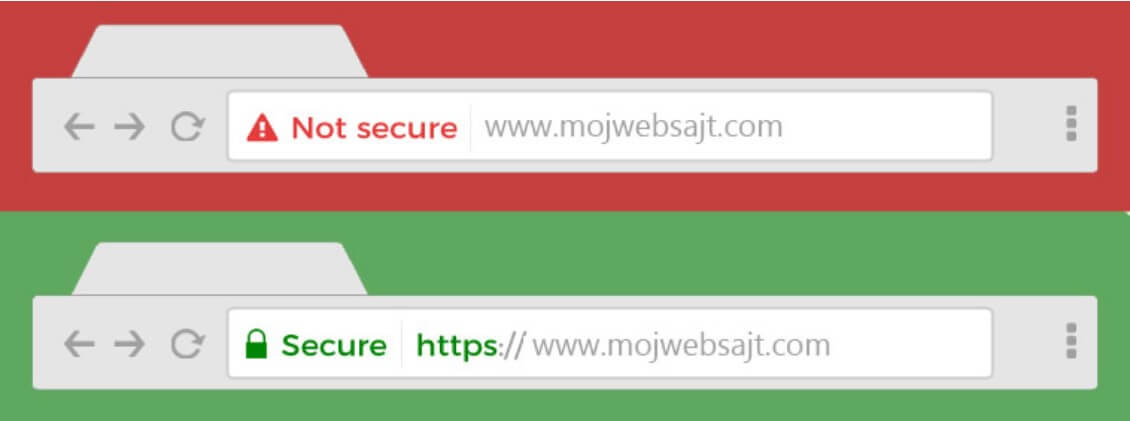
When the HTTP protocol is protected by an SSL certificate, the letter “S” is added at the end, making it HTTPS. In that case, you can be sure the website is not fake and is protected by SSL.
Benefits of SSL
The greatest advantage of having an SSL certificate is the trust and security of website visitors, who are potential customers. If customers feel safe on a website, they are more likely to complete their intended purchase without fearing that someone will steal their data or money. If the website displays a closed padlock icon or the beginning of its address appears in green, you can
be sure you're in a safe place.
Another important benefit of having SSL is search engine ranking. In 2006, Google introduced HTTPS connections as a ranking factor in its results, and since July 2018 all websites without SSL have been marked as not secure. So, if website owners want the best possible position on Google to attract more visitors and customers, they'll need an SSL certificate alongside the use of various SEO techniques.
How does an SSL certificate work?
As we have already said, SSL is a protocol that protects data between the service provider and the website visitor through encryption. Many popular websites use this protocol to protect their customers' data. In the next paragraph, we will use a fictional example to show how SSL works.
Imagine Marija owns a flower shop and has decided to expand her services through an online shop. Marija wants her customers to feel safe buying flowers from her online shop. To protect against unwanted visitors who could compromise her clients' data security, Marija must choose the type of SSL certificate she wants and purchase it. The certification authority then verifies the reliability of Marija's information and issues a certificate, which she installs on her server. When a customer visits Marija's website and decides to make a purchase, a handshake takes place between the customer's browser and the website's certificate, enabling protection of the customer's data.

Implementing SSL
An SSL certificate can be purchased through foreign companies or some local companies. The latter may be a better option because the price includes technical support if you have a problem installing the certificate or redirecting traffic to an SSL connection.
Finally, it is important to mention once again that having an SSL certificate protects the customer and builds trust between them and the organization trading online. Future cooperation rests on security and trust, which are extremely important if you want your online shop to continue operating successfully.